Monday, March 19, 2018

PPACA Premiums Could Rise 12-32% Next Year

... Consumer behavior itself, such as the mix of enrollees and their use of health services, is likely to increase premiums by 7 percent in each of the next three years.

Milliman, which conducted the analysis, said the cumulative effect is that premiums could rise by more than 90 percent through 2021.

Expected rate increases will vary wildly across the nation, analysts warned, but said states that promote their markets or take steps to regulate prices down would fare better than others.

Taxpayer-funded subsidies will blunt rising costs for most people on Obamacare's exchanges, but several million Americans will take it on the chin. ...
 

Yet Another Study: Wellness Programs Are Not Generating Medical Savings

The Affordable Care Act required the CMS conduct an independent evaluation of wellness programs that targeted various health conditions experienced by Medicare beneficiaries, and that study found no evidence of cost savings.

"Utilization and expenditures actually increased among (chronic-care management) program participants," the report said.

The findings are based on spending data for Medicare enrollees in fall prevention, weight loss and chronic care initiatives. The CMS followed beneficiaries one year after they joined a wellness program.

The results mirror those found in the corporate world, where companies are increasingly funding wellness programs meant to improve employees' health.

Corporate wellness spending hit $8 billion in 2016, up from $1 billion in 2011, according to researchers The Harris School of Public Policy at the University of Chicago.

Researchers have also found that these efforts have aided in employee retention, but not changes in employee behavior or cuts in healthcare spending. ...
 

Sunday, March 18, 2018

Bill to Improve HSAs Would Permit Pre-Deductible Coverage of Preventive Care

The Bipartisan HSA Improvement Act will make HSAs more useful and effective for employers, according to the American Benefits Council. The bill was introduced recently by Representatives Mike Kelly (R-PA), Earl Blumenauer (D-OR), Erik Paulsen (R-MN) and Ron Kind (D-WI).

“Workplace-based health insurance covers more than 178 million people nationwide, compelling employers to be innovative in managing rising health care costs,” Council President James A. Klein said. “Not only will the Bipartisan HSA Improvement Act give employers more flexibility in HSA-based plan design, it will also allow HSAs to take full advantage of cost-saving innovations like chronic care management and onsite and near-site health centers.”

The bill includes provisions that would:
  • Clarify that certain services and prescription drugs that prevent chronic disease progression are preventive care that will not be subject to a deductible;
  • Allow employers to provide primary care, chronic disease prevention, and other high-value services at on-site and near-site medical clinics without imposing a deductible;
  • Permit the use of HSA funds to pay for medical expenses for adult children up to age 26; and
  • Permit HSA contributions if a spouse has a health FSA.
As Klein noted in a letter of support for the legislation, our employer-based health insurance system “is predicated on smart tax incentives and companies’ ability to design and offer plans that best suit the needs of a modern workforce. HSAs are the direct descendants of this sound public policy, allowing employees and their families to take greater control of their health care.”
​

Wednesday, March 7, 2018

Possible Employer Action Required - IRS Reduces HSA Limit for Family Coverage for 2018

The Tax Cuts and Jobs Act (“Tax Act”) enacted late last year has affected the 2018 calendar year maximum Health Savings Account (HSA) contribution for individuals with family coverage under a high deductible health plan (HDHP). On March 5, 2018, the Internal Revenue Service (IRS) released Revenue Procedure 2018-18 which announced that the maximum contribution for those with family coverage has been reduced from $6,900 to $6,850. This reduction was triggered by the Tax Act’s changes to the operation of the consumer price index for making annual adjustments to the HSA limits. The IRS’ other HSA and HDHP limits for 2018 remain the same.

This reduction is particularly important for any individual with family HDHP coverage who has already contributed $6,900 for 2018 and must receive a refund of the excess contribution in order to avoid an excise tax.

Action Steps:
  • Employers with HDHPs should inform employees about the reduced HSA contribution limit for family HDHP coverage. Employees may need to change their HSA elections going forward to comply with the new limit. Also, any individuals with family HDHP coverage who have already contributed $6,900 for 2018 must receive a refund of the excess contribution in order to avoid an excise tax.
Our Legislative Alert contains additional information on this reduction in the maximum HSA contribution for those with family HDHP coverage.

Monday, March 5, 2018

Paying Employees to Shop Around For Better Healthcare Prices

From the Washington Post: 
Maine’s law, adopted last year, requires insurers that sell coverage to small businesses to offer financial incentives — such as gift cards, discounts on deductibles or direct payments — to encourage patients, starting in 2019, to shop around. 
A second and possibly more controversial provision also kicks in next year, requiring insurers, except HMOs, to allow patients to go out-of-network for care if they can find comparable services for less than the average price insurers pay in network. 
Similar provisions are included in a West Virginia bill now under debate. 
Touted by proponents as a way to promote health care choice, it nonetheless raises questions about how the out-of-network price would be calculated, what information would be publicly disclosed about how much insurers actually pay different hospitals, doctors or clinics for care and whether patients can find charges lower than in-network negotiated rates. 
“Mathematically, that just doesn’t work” because out-of-network charges are likely to be far higher than negotiated in-network rates, said Joe Letnaunchyn, president and CEO of the West Virginia Hospital Association. 
Not necessarily, counters the bill’s sponsor, Del. Eric Householder, who said he introduced the measure after speaking with the Foundation for Government Accountability. The Republican from the Martinsburg area said “the biggest thing lacking right now is health care choice because we’re limited to our in-network providers.” 
Shopping for health care faces other challenges. For one thing, much of medical care is not “shoppable,” meaning it falls in the category of emergency services. But things such as blood tests, imaging exams, cancer screening tests and some drugs that are administered in doctor’s offices are fair game.
Full story.
 

Saturday, February 10, 2018

Budget Deal Boosts Healthcare Programs, Owners in HRAs, COBRA & HRAs, and Top Issues with Medical Management Carve-Outs

Health Care Reform News: 

House passes deal to end shutdown
February 9, 2018 – The Hill
Excerpt: “The House approved a sweeping budget deal early Friday morning that would fund the government through March 23, sending legislation to President Trump that would end a brief shutdown of the government that began at midnight.”

Bipartisan Senate Budget Deal Boosts Health Programs
February 7, 2018 – Kaiser Health News
Excerpt: “In a rare show of bipartisanship for the mostly polarized 115th Congress, Republican and Democratic Senate leaders announced a two-year budget deal that would increase federal spending for defense as well as key domestic priorities, including many health programs.”

Questions and Answers about Information Reporting by Employers on Form 1094-C and Form 1095-C
February 6, 2018 – The Internal Revenue Service
Excerpt: “These Q&As provide additional information about completing Form 1094-C and Form 1095-C for calendar year 2017 that are to be filed in 2018. The Q&As may be used in conjunction with the Instructions for Forms 1094-C and 1095-C, which provide detailed information about completing the forms.”

In Other News:

Information Letter Addresses Calculation of COBRA Premium for HRA
February 8, 2018 – Thomson Reuters
Excerpt: “The information letter explains generally that an employer may charge the “applicable premium” for COBRA coverage, which is the cost to the plan of coverage for similarly situated beneficiaries for whom a qualifying event has not occurred, plus a 2% administrative fee.”

Can a Company’s Owners Participate in Its HRA?
February 8, 2018 – Thomson Reuters
Excerpt: “While self-employed individuals cannot participate in HRAs, they can have HSAs, although they cannot receive tax-free contributions to their HSAs through a cafeteria plan.”

AI mines EHR data to predict diabetic patients at risk for kidney damage, study finds
February 5, 2018 – Healthcare IT News
Excerpt: “By isolating less than 5 percent of the 400,000 diabetic population selected among the company's database of 15 million patients, the algorithm was able to identify 45 percent of patients who would progress to significant kidney damage within a year, prior to becoming symptomatic, the start-up reported. This represents 25 percent more patients than would have been identified by commonly used clinical tools and judgment, the company contended.”

Top 10 Questions re: Management Carve Outs in Group Health Plans
February 2, 2018 – E is for ERISA
Excerpt: “One issue that remains perpetually murky, in this regard, is the legality of management carve-outs, whereby an employer offers certain group health insurance options or classes of coverage only to management or other highly paid groups. The following true or false discusses some of the rules that come into play.”

Medicare Part D Disclosures due by March 1, 2018 for Calendar Year Plans
February 1, 2018 – BB&T Insurance Services
Excerpt: “The plan sponsor must complete the online disclosure within 60 days after the beginning of the plan year. For calendar year health plans, the deadline for the annual online disclosure is March 1.”

Changes to ERISA’s Disability Claims Regulations Coming April 1
January 31, 2018 – Jackson Lewis P.C.
Excerpt: “Employers who offer short-term and long-term disability plans governed by ERISA (and their plan administrators) need to prepare for the approaching deadline. This article provides background on the flux of the regulations and offers steps to take now to ensure timely compliance.”
 

Tuesday, January 2, 2018

Provisions in the New Tax Reform Law Affecting Employee Benefits

As compiled by the fine folks over at BenefitsLink. Newest publications are first.

Tax Reform Provisions Affecting Employer-Provided Compensation and Benefits (PDF)
Trucker Huss
Dec. 28, 2017
"[1] Repeal of performance-based compensation exception to $1,000,000 deduction limit ... [2] Excessive compensation of non-profit covered employees subject to a 21% tax penalty ... [3] Limits and phase-out on deduction for employer-operated eating facilities ... [4] Elimination of employer deduction for certain transportation fringe benefits ... [5] Suspension of income exclusion for qualified bicycle commuting reimbursement fringe benefit ... [6] Suspension of income exclusion and employer deduction for qualified moving expense reimbursement ... [7] Extension of rollover period for plan loan offsets ... [8] Employer credit for paid family and medical leave."

The Impact of the 2017 Tax Reforms on Employment-Based Benefits and Executive Compensation (PDF)
BakerHostetler
Dec. 26, 2017
"[A] new 'Qualified Equity Grant' ... to allow employees of nonpublicly traded companies to elect to defer taxation of stock options and restricted stock units (RSUs) for up to five years after the exercise of such stock options or the vesting of RSUs.... Repeal of 'recharacterization' of Roth IRA conversions ... Extended rollover periods for deemed distributions of retirement plan loans ... Tax relief for retirement plan distributions to relieve 2016 major disasters ... New credit for paid family and medical leave."

Tax Legislation Includes Significant Executive Comp and Employee Benefits Provisions (PDF)

EY
Dec. 22, 2017
27 pages. "The Conference Report confirms that compensation paid pursuant to a plan qualifies for the exception under the transition rule, but only if the right to participate in the plan is part of a written binding contract with the covered employee in effect on November 2, 2017.... Additional questions may arise regarding plans or agreements that may be terminated prospectively and what portion of the deferred compensation accrued under the plan or agreement after the effective date is grandfathered.... The new Section 4960 21% excise tax would add a significant financial and administrative burden on tax-exempt organizations with highly compensated employees."

What the New Tax Law Likely Will and Won't Do to the Nation's Health Care

Association of Health Care Journalists
Dec. 22, 2017
"As many of us have speculated about what insurers will do regarding future exchange participation, Jeff Young from the Huffington Post actually called a bunch of them. None have said they were running straight for the exits, but many sound very cautious about the 'big mess' ahead sans mandate."

Tax Reform Law Includes Paid Leave Provisions
Fisher Phillips
Dec. 22, 2017
"Section 13403 of the Act offers businesses a tax credit if they offer up to 12 weeks of paid family leave to certain eligible workers. Eligible employers must have a written policy that provides not less than two weeks of annual paid family and medical leave for full-time employees, and a pro-rata amount provided at the same ratio for part-time employees. The policy must provide payment at a rate not less than 50 percent of the wages normally paid to employees on leave."

Paid Leave, Other Job-Related Measures Stay in Tax Bill

Bloomberg BNA
Dec. 19, 2017
"Incentives for companies to offer their workers paid leave, in addition to prohibiting deductions related to confidential settlements related to sexual misconduct, are part of the final version of a Republican tax reform bill ... That includes offering businesses a credit for offering up to 12 weeks of paid family leave. The measure, plucked from a stand-alone bill (S. 344) by Sen. Deb Fischer (R-Neb.), also includes incentives for offering medical leave."

Tax Bill: How Four Healthcare Measures Weathered Reconciliation

HealthLeaders Media
Dec. 19, 2017
"[1] Individual mandate repeal included ... [2] Medical expense deduction expansion ... [3] Orphan drug tax credit reduction ... [4] Private activity bonds preserved."

New Deadline for Furnishing Form 1095-C to Employees

1095–C Filing Requirements

Under Section 6056 of the Affordable Care Act, Applicable Large Employers (ALEs) must file information returns with the IRS and furnish statements to full-time employees . Forms are due in the year after the calendar year to which the forms relate. 

IRS Announces Extension of Deadline to Furnish Form 1095-C to Employees

On Dec. 22, 2017, the Internal Revenue Service (IRS) issued Notice 2018-06 which extended the deadline to furnish Forms 1095-C and 1095-B to full-time employees and covered individuals by thirty days. The deadline for furnishing these Forms is now March 2, 2018.  This Notice also extended good faith transition relief for reporting penalties for employers that make a good faith and timely effort to report. 

Notice 2018-06 does not extend the due date for filing forms with the IRS for 2017 and those dates remain February 28, 2018 or April 2, 2018, if filing electronically.  
Penalties

An ALE may face penalties if it fails to satisfy its Section 6056 reporting obligations. 
These penalties are separate from the ACA’s employer shared responsibility penalties.

For returns required to be filed in 2016 and later, the base penalty amounts under 
Sections 6721 and 6722 were increased. In addition, these amounts are indexed to 
increase with inflation each year. The adjusted penalty amounts are as follows:


Remember, for those employers that use the W-2 safe harbor for affordability, you will need to know an employee’s 2017 W-2 box 1 compensation in order to complete Form 1095-C for that employee.

Monday, December 18, 2017

Chart: How the New Tax Bill Could Impact You

From NPR:

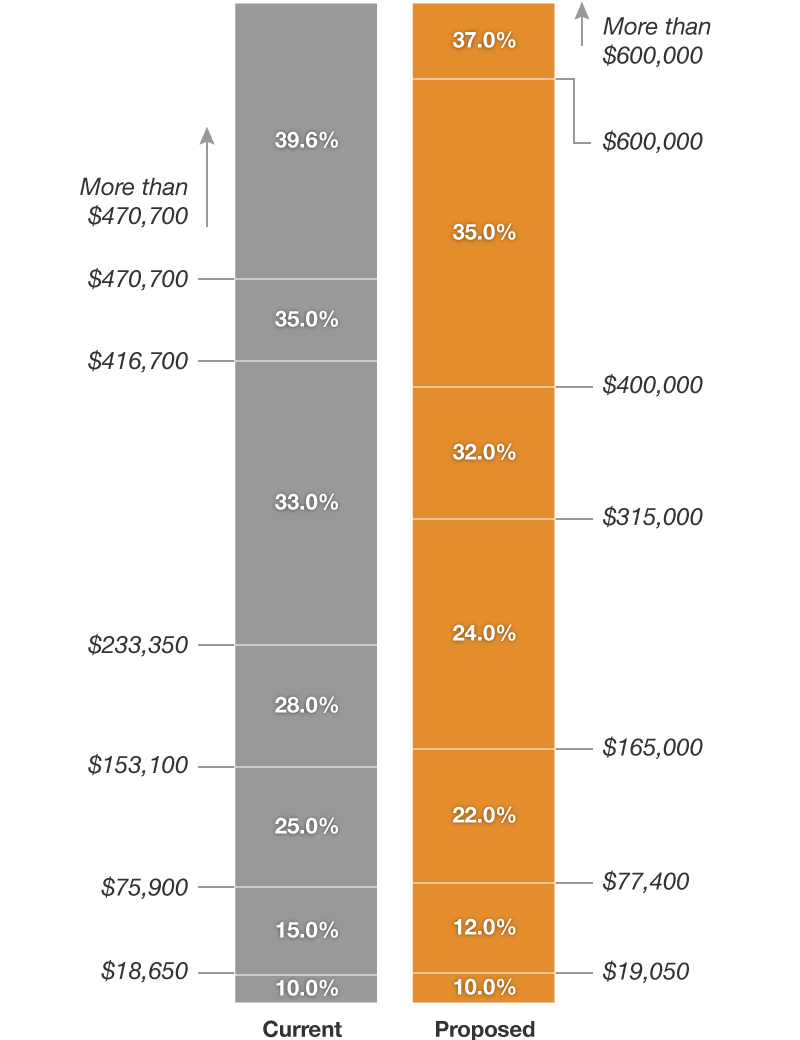
Tax Brackets Under The Proposed Plan

chart showing different tax brackets for married filing jointly


How Proposed Tax Code Changes Affect …

People who take the standard deduction

CURRENT LAW
In 2018, single taxpayers will deduct $6,500, and married couples will deduct $13,000. Then, taxpayers can add in exemptions — $4,150 for each qualifying person, including oneself. For a single person, this comes out to $10,650. For a hypothetical two-parent home with two kids, it would come out to $13,000 plus four times $4,150, or $29,600.
PROPOSED: TAX CUTS AND JOBS ACT
A single taxpayer would deduct $12,000, a head of household would deduct $18,000, and a married couple would deduct $24,000. However, none will tack on any additional exemptions.

This means that single person would deduct $12,000 and not $10,650. The single parent would deduct $18,000 and not $17,650. Meanwhile, the two-parent home with two kids would get a $24,000 deduction now, not $29,600. However, that household could also get a bigger child tax credit.

In other words, the total of the standard deduction plus exemptions would be smaller for some families with multiple children than it was before. The repeal of personal exemptions would sunset after 2025.

A nearly doubled standard deduction would also mean fewer taxpayers itemizing their deductions, which Republicans argue would make it easier to do their taxes.

Parents

CURRENT LAW
Taxpayers deduct a set amount — $4,150 per qualifying child — from their taxable income. Then, they apply the child tax credit by subtracting up to $1,000 per child from the final tax bill. (The total amount depends on a tax filer’s income; the credit phases out as income gets higher.) People can apply for a refundable additional child tax credit, which gives them some money back if their total tax liability is zero.

Employees can exclude the value of up to $5,000 in employer-provided dependent care assistance from their income. In these programs, employers might reimburse employees for child care by means of a flexible spending account, for example.

People can also get a child and dependent care credit of up to $3,000 for the cost of caring for a child or other dependent (or $6,000 for more than one child or dependent). In addition, there is an adoption tax credit of $13,750 per child.
PROPOSED: TAX CUTS AND JOBS ACT
Taxpayers would not apply exemptions for their children. They would, however, apply a larger child tax credit, of up to $2,000 per child. This could help families make up for the loss of exemptions (as explained above). It would also make the credit refundable up to $1,400 — meaning that people who owe nothing in federal income taxes could still get up to $1,400 back from this tax credit. The bill would create an additional $500 tax credit for nonchild dependents. These provisions would expire after 2025.

The bill also keeps the adoption tax credit and the dependent care exclusion.

People with 401(k) accounts

CURRENT LAW
Taxpayers can contribute up to $18,500 in pretax income to tax-preferred retirement accounts like 401(k)s for tax year 2018.
PROPOSED: TAX CUTS AND JOBS ACT
Despite some talk initially of lowering the limit on 401(k) contributions, this would not change.

People who deduct state and local taxes

CURRENT LAW
Tax filers who itemize deductions can deduct different types of state and local taxes from their taxable income on their federal tax returns.
PROPOSED: TAX CUTS AND JOBS ACT
Itemizers could still deduct state and local taxes, but only up to $10,000. That $10,000 could include property taxes and either sales or income taxes.

People who plan to leave their relatives very (very) large estates

CURRENT LAW
Taxes must be paid on any estate with assets worth more than $5.6 million for tax year 2018 (or $11.2 million per married couple). The tax rate on those assets ranges from 18 percent to 40 percent, depending on the size of the estate. Right now, only a tiny sliver of the very wealthiest estates are subject to this tax.
PROPOSED: TAX CUTS AND JOBS ACT
The estate tax exemption would immediately double, meaning individual estates would be taxed only on assets of more than $11.2 million for tax year 2018.

Small-business owners

CURRENT LAW
Sole proprietorships, as well as a few other types of businesses (not all of them small), are taxed through the individual income tax code and at individual income tax rates. (For this reason, they are often called “pass through” businesses, as their income gets passed on to the owner, who files the taxes with her income tax returns.)
PROPOSED: TAX CUTS AND JOBS ACT
The bill would allow pass-through-business owners to deduct a portion of their business income. The deductible amount would be smaller for some higher-income pass throughs. In addition, the bill includes provisions to try to keep high-income wage earners from converting to pass-through businesses to take advantage of the deduction. Altogether, the bill would limit the effective tax rate on these businesses to no more than 29.6 percent.

Homeowners

CURRENT LAW
Homeowners who itemize their deductions can deduct the interest paid on up to $1 million of their mortgage principal.
PROPOSED: TAX CUTS AND JOBS ACT
The deduction would be limited to up to $750,000 of new mortgages, not $1 million. It would allow homeowners to deduct the interest on mortgages from both first and second homes and would not affect existing mortgages. The provision would expire after 2025.

People with large medical expenses

CURRENT LAW
Taxpayers can deduct the cost of out-of-pocket medical expenses, if the total cost exceeds 10 percent of the taxpayer’s adjusted gross income.
PROPOSED: TAX CUTS AND JOBS ACT
The bill would lower the floor for deductible expenses to 7.5 percent of adjusted gross income, but only in 2018 and 2019. It would revert to 10 percent in 2020.

College and graduate students

CURRENT LAW
A variety of tax policies benefit current students and college graduates. Taxpayers whose colleges or universities give them tuition reductions, often called “tuition waivers,” can exclude that amount from their income.

Workers may also exclude up to $5,250 in employer-provided education assistance from their taxes. Taxpayers may also deduct some tuition and student loan interest payments from their taxes. In addition, tax credits including the American opportunity tax credit, Hope Scholarship credit and lifetime learning credit help students afford their education.
PROPOSED: TAX CUTS AND JOBS ACT
The bill would preserve these credits, as well as tuition waivers.

People with health insurance

CURRENT LAW
People must purchase health insurance or pay a penalty on their taxes — a provision known as the “individual mandate.”
PROPOSED: TAX CUTS AND JOBS ACT
The individual mandate penalty would be reduced to zero. This would mean some people would choose not to purchase insurance and that others would not be able to afford it.

Friday, December 15, 2017

House Unveils Package to Delay ObamaCare Taxes and Employer Mandate

From the Hill:  
House Republicans on Tuesday unveiled a package of bills to delay a range of ObamaCare taxes, which could be acted on later this month. 
House Ways and Means Chairman Kevin Brady (R-Texas) led the announcement for the bills to delay ObamaCare’s tax on medical devices for five years, on health insurance for two years, and the "Cadillac tax" on high-cost health plans for one year. The package would also eliminate penalties for employers who do not offer health insurance to their workers, under the employer mandate, through 2018. 
The bills are only supported by Republicans at the moment, but they come after bipartisan negotiations with Democrats on delaying the taxes, a move that has support on both sides of the aisle. The package could be attached as part of a bipartisan deal on a year-end government funding bill. 
The delay of these taxes would be a victory for industries, like medical device companies and health insurers, that have pushed against the taxes. Those groups are still pushing for full repeal eventually. ...
 

Wednesday, November 29, 2017

Big Government: The Average Wait Time For Those Seeking Disability Pay Is Now 633 Days

...Under Social Security, about 150 million workers are insured not only for old age benefits, but in the event they suffer a serious injury or illness that prevents them from working before retirement age. Currently, 8.7 million disabled workers get an average of $1,172 a month — barely enough to live on. 
But since 2010, Congress has squeezed the Social Security Administration’s operating budget, resulting in an 11 percent cut when accounting for inflation. The effect: staff reductions, a quintupling of hold times for telephone assistance, and a backlog in claims processing that has reached an all-time high. 
The agency has closed 65 of its field offices since 2010, including in Corona, Redlands and Barstow. Overall, California field staff is down 14 percent. 
For claimants in the pipeline, the delays are “devastating,” Lisa Ekman, an official with the Consortium for Citizens with Disabilities, a coalition of some 100 nonprofits, told a Congressional hearing in September. “Some become homeless. Some declare bankruptcy. And some die.” 
Social Security officials counted 10,002 people who died in FY 2017 while waiting for a hearing. Many more, without income, grew sicker. ...