Tuesday, January 2, 2018

Provisions in the New Tax Reform Law Affecting Employee Benefits

As compiled by the fine folks over at BenefitsLink. Newest publications are first.

Tax Reform Provisions Affecting Employer-Provided Compensation and Benefits (PDF)
Trucker Huss
Dec. 28, 2017
"[1] Repeal of performance-based compensation exception to $1,000,000 deduction limit ... [2] Excessive compensation of non-profit covered employees subject to a 21% tax penalty ... [3] Limits and phase-out on deduction for employer-operated eating facilities ... [4] Elimination of employer deduction for certain transportation fringe benefits ... [5] Suspension of income exclusion for qualified bicycle commuting reimbursement fringe benefit ... [6] Suspension of income exclusion and employer deduction for qualified moving expense reimbursement ... [7] Extension of rollover period for plan loan offsets ... [8] Employer credit for paid family and medical leave."

The Impact of the 2017 Tax Reforms on Employment-Based Benefits and Executive Compensation (PDF)
BakerHostetler
Dec. 26, 2017
"[A] new 'Qualified Equity Grant' ... to allow employees of nonpublicly traded companies to elect to defer taxation of stock options and restricted stock units (RSUs) for up to five years after the exercise of such stock options or the vesting of RSUs.... Repeal of 'recharacterization' of Roth IRA conversions ... Extended rollover periods for deemed distributions of retirement plan loans ... Tax relief for retirement plan distributions to relieve 2016 major disasters ... New credit for paid family and medical leave."

Tax Legislation Includes Significant Executive Comp and Employee Benefits Provisions (PDF)

EY
Dec. 22, 2017
27 pages. "The Conference Report confirms that compensation paid pursuant to a plan qualifies for the exception under the transition rule, but only if the right to participate in the plan is part of a written binding contract with the covered employee in effect on November 2, 2017.... Additional questions may arise regarding plans or agreements that may be terminated prospectively and what portion of the deferred compensation accrued under the plan or agreement after the effective date is grandfathered.... The new Section 4960 21% excise tax would add a significant financial and administrative burden on tax-exempt organizations with highly compensated employees."

What the New Tax Law Likely Will and Won't Do to the Nation's Health Care

Association of Health Care Journalists
Dec. 22, 2017
"As many of us have speculated about what insurers will do regarding future exchange participation, Jeff Young from the Huffington Post actually called a bunch of them. None have said they were running straight for the exits, but many sound very cautious about the 'big mess' ahead sans mandate."

Tax Reform Law Includes Paid Leave Provisions
Fisher Phillips
Dec. 22, 2017
"Section 13403 of the Act offers businesses a tax credit if they offer up to 12 weeks of paid family leave to certain eligible workers. Eligible employers must have a written policy that provides not less than two weeks of annual paid family and medical leave for full-time employees, and a pro-rata amount provided at the same ratio for part-time employees. The policy must provide payment at a rate not less than 50 percent of the wages normally paid to employees on leave."

Paid Leave, Other Job-Related Measures Stay in Tax Bill

Bloomberg BNA
Dec. 19, 2017
"Incentives for companies to offer their workers paid leave, in addition to prohibiting deductions related to confidential settlements related to sexual misconduct, are part of the final version of a Republican tax reform bill ... That includes offering businesses a credit for offering up to 12 weeks of paid family leave. The measure, plucked from a stand-alone bill (S. 344) by Sen. Deb Fischer (R-Neb.), also includes incentives for offering medical leave."

Tax Bill: How Four Healthcare Measures Weathered Reconciliation

HealthLeaders Media
Dec. 19, 2017
"[1] Individual mandate repeal included ... [2] Medical expense deduction expansion ... [3] Orphan drug tax credit reduction ... [4] Private activity bonds preserved."

New Deadline for Furnishing Form 1095-C to Employees

1095–C Filing Requirements

Under Section 6056 of the Affordable Care Act, Applicable Large Employers (ALEs) must file information returns with the IRS and furnish statements to full-time employees . Forms are due in the year after the calendar year to which the forms relate. 

IRS Announces Extension of Deadline to Furnish Form 1095-C to Employees

On Dec. 22, 2017, the Internal Revenue Service (IRS) issued Notice 2018-06 which extended the deadline to furnish Forms 1095-C and 1095-B to full-time employees and covered individuals by thirty days. The deadline for furnishing these Forms is now March 2, 2018.  This Notice also extended good faith transition relief for reporting penalties for employers that make a good faith and timely effort to report. 

Notice 2018-06 does not extend the due date for filing forms with the IRS for 2017 and those dates remain February 28, 2018 or April 2, 2018, if filing electronically.  
Penalties

An ALE may face penalties if it fails to satisfy its Section 6056 reporting obligations. 
These penalties are separate from the ACA’s employer shared responsibility penalties.

For returns required to be filed in 2016 and later, the base penalty amounts under 
Sections 6721 and 6722 were increased. In addition, these amounts are indexed to 
increase with inflation each year. The adjusted penalty amounts are as follows:


Remember, for those employers that use the W-2 safe harbor for affordability, you will need to know an employee’s 2017 W-2 box 1 compensation in order to complete Form 1095-C for that employee.

Monday, December 18, 2017

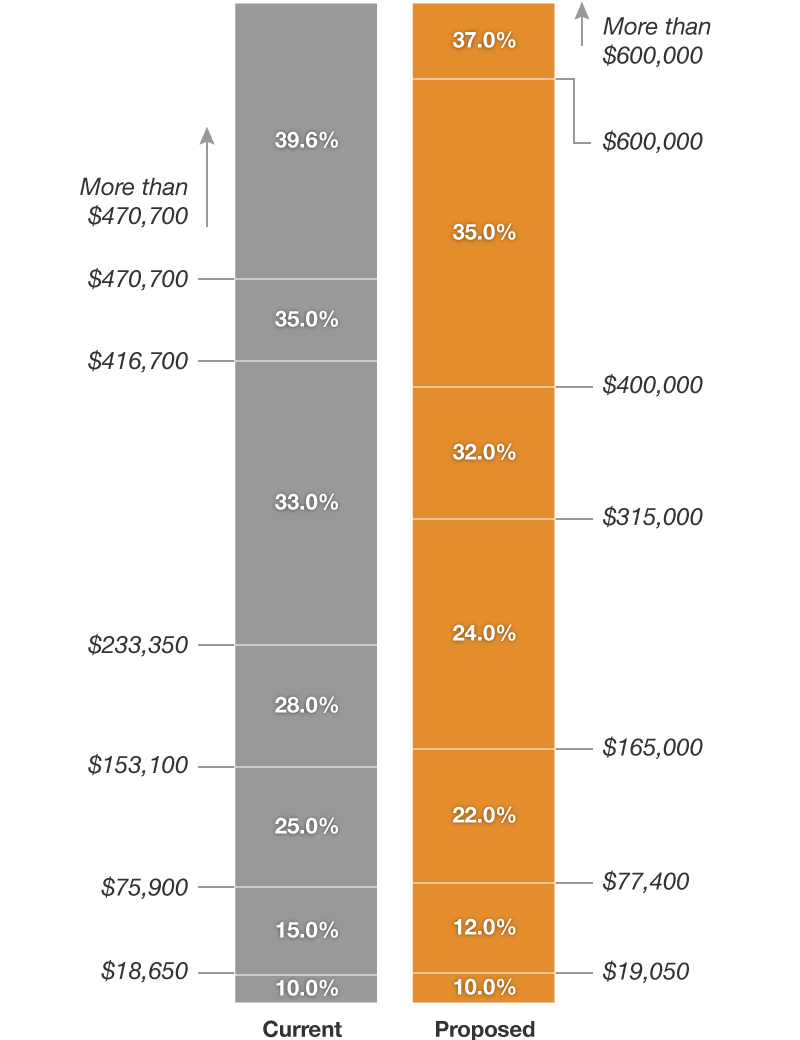
Chart: How the New Tax Bill Could Impact You

From NPR:

Tax Brackets Under The Proposed Plan

chart showing different tax brackets for married filing jointly


How Proposed Tax Code Changes Affect …

People who take the standard deduction

CURRENT LAW
In 2018, single taxpayers will deduct $6,500, and married couples will deduct $13,000. Then, taxpayers can add in exemptions — $4,150 for each qualifying person, including oneself. For a single person, this comes out to $10,650. For a hypothetical two-parent home with two kids, it would come out to $13,000 plus four times $4,150, or $29,600.
PROPOSED: TAX CUTS AND JOBS ACT
A single taxpayer would deduct $12,000, a head of household would deduct $18,000, and a married couple would deduct $24,000. However, none will tack on any additional exemptions.

This means that single person would deduct $12,000 and not $10,650. The single parent would deduct $18,000 and not $17,650. Meanwhile, the two-parent home with two kids would get a $24,000 deduction now, not $29,600. However, that household could also get a bigger child tax credit.

In other words, the total of the standard deduction plus exemptions would be smaller for some families with multiple children than it was before. The repeal of personal exemptions would sunset after 2025.

A nearly doubled standard deduction would also mean fewer taxpayers itemizing their deductions, which Republicans argue would make it easier to do their taxes.

Parents

CURRENT LAW
Taxpayers deduct a set amount — $4,150 per qualifying child — from their taxable income. Then, they apply the child tax credit by subtracting up to $1,000 per child from the final tax bill. (The total amount depends on a tax filer’s income; the credit phases out as income gets higher.) People can apply for a refundable additional child tax credit, which gives them some money back if their total tax liability is zero.

Employees can exclude the value of up to $5,000 in employer-provided dependent care assistance from their income. In these programs, employers might reimburse employees for child care by means of a flexible spending account, for example.

People can also get a child and dependent care credit of up to $3,000 for the cost of caring for a child or other dependent (or $6,000 for more than one child or dependent). In addition, there is an adoption tax credit of $13,750 per child.
PROPOSED: TAX CUTS AND JOBS ACT
Taxpayers would not apply exemptions for their children. They would, however, apply a larger child tax credit, of up to $2,000 per child. This could help families make up for the loss of exemptions (as explained above). It would also make the credit refundable up to $1,400 — meaning that people who owe nothing in federal income taxes could still get up to $1,400 back from this tax credit. The bill would create an additional $500 tax credit for nonchild dependents. These provisions would expire after 2025.

The bill also keeps the adoption tax credit and the dependent care exclusion.

People with 401(k) accounts

CURRENT LAW
Taxpayers can contribute up to $18,500 in pretax income to tax-preferred retirement accounts like 401(k)s for tax year 2018.
PROPOSED: TAX CUTS AND JOBS ACT
Despite some talk initially of lowering the limit on 401(k) contributions, this would not change.

People who deduct state and local taxes

CURRENT LAW
Tax filers who itemize deductions can deduct different types of state and local taxes from their taxable income on their federal tax returns.
PROPOSED: TAX CUTS AND JOBS ACT
Itemizers could still deduct state and local taxes, but only up to $10,000. That $10,000 could include property taxes and either sales or income taxes.

People who plan to leave their relatives very (very) large estates

CURRENT LAW
Taxes must be paid on any estate with assets worth more than $5.6 million for tax year 2018 (or $11.2 million per married couple). The tax rate on those assets ranges from 18 percent to 40 percent, depending on the size of the estate. Right now, only a tiny sliver of the very wealthiest estates are subject to this tax.
PROPOSED: TAX CUTS AND JOBS ACT
The estate tax exemption would immediately double, meaning individual estates would be taxed only on assets of more than $11.2 million for tax year 2018.

Small-business owners

CURRENT LAW
Sole proprietorships, as well as a few other types of businesses (not all of them small), are taxed through the individual income tax code and at individual income tax rates. (For this reason, they are often called “pass through” businesses, as their income gets passed on to the owner, who files the taxes with her income tax returns.)
PROPOSED: TAX CUTS AND JOBS ACT
The bill would allow pass-through-business owners to deduct a portion of their business income. The deductible amount would be smaller for some higher-income pass throughs. In addition, the bill includes provisions to try to keep high-income wage earners from converting to pass-through businesses to take advantage of the deduction. Altogether, the bill would limit the effective tax rate on these businesses to no more than 29.6 percent.

Homeowners

CURRENT LAW
Homeowners who itemize their deductions can deduct the interest paid on up to $1 million of their mortgage principal.
PROPOSED: TAX CUTS AND JOBS ACT
The deduction would be limited to up to $750,000 of new mortgages, not $1 million. It would allow homeowners to deduct the interest on mortgages from both first and second homes and would not affect existing mortgages. The provision would expire after 2025.

People with large medical expenses

CURRENT LAW
Taxpayers can deduct the cost of out-of-pocket medical expenses, if the total cost exceeds 10 percent of the taxpayer’s adjusted gross income.
PROPOSED: TAX CUTS AND JOBS ACT
The bill would lower the floor for deductible expenses to 7.5 percent of adjusted gross income, but only in 2018 and 2019. It would revert to 10 percent in 2020.

College and graduate students

CURRENT LAW
A variety of tax policies benefit current students and college graduates. Taxpayers whose colleges or universities give them tuition reductions, often called “tuition waivers,” can exclude that amount from their income.

Workers may also exclude up to $5,250 in employer-provided education assistance from their taxes. Taxpayers may also deduct some tuition and student loan interest payments from their taxes. In addition, tax credits including the American opportunity tax credit, Hope Scholarship credit and lifetime learning credit help students afford their education.
PROPOSED: TAX CUTS AND JOBS ACT
The bill would preserve these credits, as well as tuition waivers.

People with health insurance

CURRENT LAW
People must purchase health insurance or pay a penalty on their taxes — a provision known as the “individual mandate.”
PROPOSED: TAX CUTS AND JOBS ACT
The individual mandate penalty would be reduced to zero. This would mean some people would choose not to purchase insurance and that others would not be able to afford it.

Friday, December 15, 2017

House Unveils Package to Delay ObamaCare Taxes and Employer Mandate

From the Hill:  
House Republicans on Tuesday unveiled a package of bills to delay a range of ObamaCare taxes, which could be acted on later this month. 
House Ways and Means Chairman Kevin Brady (R-Texas) led the announcement for the bills to delay ObamaCare’s tax on medical devices for five years, on health insurance for two years, and the "Cadillac tax" on high-cost health plans for one year. The package would also eliminate penalties for employers who do not offer health insurance to their workers, under the employer mandate, through 2018. 
The bills are only supported by Republicans at the moment, but they come after bipartisan negotiations with Democrats on delaying the taxes, a move that has support on both sides of the aisle. The package could be attached as part of a bipartisan deal on a year-end government funding bill. 
The delay of these taxes would be a victory for industries, like medical device companies and health insurers, that have pushed against the taxes. Those groups are still pushing for full repeal eventually. ...
 

Wednesday, November 29, 2017

Big Government: The Average Wait Time For Those Seeking Disability Pay Is Now 633 Days

...Under Social Security, about 150 million workers are insured not only for old age benefits, but in the event they suffer a serious injury or illness that prevents them from working before retirement age. Currently, 8.7 million disabled workers get an average of $1,172 a month — barely enough to live on. 
But since 2010, Congress has squeezed the Social Security Administration’s operating budget, resulting in an 11 percent cut when accounting for inflation. The effect: staff reductions, a quintupling of hold times for telephone assistance, and a backlog in claims processing that has reached an all-time high. 
The agency has closed 65 of its field offices since 2010, including in Corona, Redlands and Barstow. Overall, California field staff is down 14 percent. 
For claimants in the pipeline, the delays are “devastating,” Lisa Ekman, an official with the Consortium for Citizens with Disabilities, a coalition of some 100 nonprofits, told a Congressional hearing in September. “Some become homeless. Some declare bankruptcy. And some die.” 
Social Security officials counted 10,002 people who died in FY 2017 while waiting for a hearing. Many more, without income, grew sicker. ...
 

Disability Claims and Appeals Delay

On Dec. 16, 2016, the Department of Labor (DOL) issued a final rule amending the claims and appeals requirements for plans providing disability benefits. The final rule was scheduled to apply to claims that are filed on or after Jan. 1, 2018. However, on Nov. 24, 2017, DOL delayed the final rule for 90 days—until April 1, 2018.

The final rule provided disability claimants with protections that are similar, but not identical to, those under the Affordable Care Act (ACA) for non-grandfathered group health plans. While not affecting the timing for responding to disability claims and appeals, the final rule provided further protections for disability claimants regarding conflicts of interest, the opportunity to respond to evidence, and the reasoning behind the benefit decision.

According to DOL, after the final rule was published, concerns were raised that its new requirements will impair workers’ access to these benefits by driving up costs.

The delay in the effective date did not change the December 11, 2017 deadline for submitting comments, data and information to DOL regarding the merits of rescinding, modifying or retaining the final rule. DOL believes the 90 day delay allows it sufficient time to complete the comment solicitation process, perform a reexamination of the information and data submitted, and take appropriate next steps. DOL did not rule out a further extension if it received reliable data and information that reasonably supported assertions that the final rule will lead to unwarranted cost increases and related diminution in disability coverage benefits.

Sponsors of plans that provide benefits for disability, including retirement plans, should continue to monitor the status of the final rule. The final rule, and any modifications to the final rule, may require an update of not only internal procedures but also plans documents, summary plan descriptions as well as all forms and letters used in the claims and appeals process.

Our Legislative Alert provides more detail on the delay in the effective date of the final rule as well as the requirements of the final rule as currently constituted.
  

Wednesday, November 22, 2017

Are You Ready for Obamacare's Employer Penalties?

From Accounting Today: 
The IRS has been sending signals since the summer that it will be enforcing the Affordable Care Act's employer mandate. 
Those signals have culminated in the IRS starting the process of sending letters to businesses with 50 or more full-time or full-time equivalent employees—referred to as Applicable Large Employers, or ALEs—on what they owe for failing to comply with the Affordable Care Act’s employer shared responsibility mandate for IRS filings related to the 2015 tax year. 
Letter 226J is the communication that provides the general procedures the IRS will use to propose and assess the ACA’s employer shared responsibility payment, or ESRP. Click here to see the sample letter on the IRS website. 
There have been reports of letters containing ACA penalties anywhere from the tens of thousands of dollars to nearly $6 million. Surely some are even higher. More are on the way. 
CPAs need to move now to prepare their clients for the possibility that they will receive their own Letter 226J. 
Letter 226J provides information on the individual employees who, for at least one month in the year, were full-time employees, were allowed a premium tax credit, and for whom the ALE did not qualify for an affordability safe harbor or other relief, as per instructions for Forms 1094-C and 1095-C, Line 16. It also provides the indicator codes for the ALE, reported on lines 14 and 16, of each assessable full-time employee’s Form 1095-C. ... 
Full story here. 
 
Resources:


Thursday, November 16, 2017

71% of California's Healthcare is Paid by Taxpayers

Obamacare achieved its goal.  71% of California's healthcare is now funded by taxpayers. It's hard to see how this reverses without some form of massive collapse or calamity.  


A Sign of the Times - Most Want More Government


Average Rate Hikes in California

Yeah, that's sustainable. From California Healthline: 
Molina Healthcare has the highest rate increase for 2018, at 44.7 percent. Valley Health Plan is lowest at 9.8 percent. 
Blue Shield of California, the largest insurer in Covered California by enrollment, fell in between with an average hike of 22.8 percent. HMO giant Kaiser Permanente will charge 11.6 percent more on average next year. (Kaiser Health News, which produces California Healthline, is not affiliated with Kaiser Permanente.) 

Monday, November 13, 2017

10 Ways Employees Can Make Themselves Ineligible for HSA Contributions

A great reminder during open enrollment season from HR Daily Advisor:  
The Top 10 List 
Without further delay, here is the Top 10 list of HSA disqualifications: 
  1. General-purpose health flexible savings account (FSA) or health reimbursement arrangement. This is among the most common disqualifications. It’s not that the employee’s employer allowed them in the general-purpose account, which reimburses any and all medical care expenses. These days employers will set up eligibility rules that only allow HSA-eligible employees in a limited purpose (dental, vision, preventive care only) or post-deductible health FSA or HRA (or a combination of the two). Instead, it is the employee’s spouse or domestic partner who has a general-purpose health FSA that covers the employee. It does not matter if the employee’s expenses are never reimbursed from the spouse’s general-purpose health FSA. That coverage is a disqualifier.
  1. Medicaid. Medicaid coverage is first-dollar medical coverage for low-income individuals. It is generally a payer of last resort, such that a low-paid new hire still might qualify for Medicaid and be eligible for employer-sponsored coverage. The HSA rules do not provide an exception for Medicaid.
  1. Medicare. Medicare enrollment, not eligibility, disqualifies a person from HSA contributions, starting on the first of the month in which Medicare begins. Age-based, disability-based, and end-stage renal disease-based Medicare all make one HSA ineligible. One rule often catches retirees by surprise. If someone retires within 6 months after reaching age 65, Medicare enrollment is retroactively effective to the first day of the birthday month. This means several months of HSA contributions could be reclassified as HSA-ineligible months.
  1. Indian Health Service (IHS) and U.S. Department of Veterans Affairs (VA) coverage. These two benefits have a lot in common when it comes to HSA eligibility. For one thing, IHS and VA coverage is based on your status (tribe membership and military service, respectively); they are not based on any type of election. Eligible individuals have this coverage whether they use it or not. Recognizing this fact, an individual can have either type of coverage and be HSA-eligible as long as they have not received care from IHS or received any VA benefits in the prior 3 months.
There are exceptions. For IHS benefits, if an individual receives dental, vision, or preventive care—even in the prior 3 months—he or she is still HSA-eligible. 
  1. TRICARE. This coverage pays benefits before the HDHP deductible is met and clearly makes one ineligible for HSA contributions. TRICARE coverage is available to active duty military personnel, including members of the Coast Guard, retired military veterans, their families, and survivors. TRICARE’s effect on HSAs is especially important to communicate for employers that hire veterans in large numbers.
  1. On-site medical clinics. This type of coverage is appealing to employers with large populations at one or more work locations. Time off can be minimized when the healthcare provider is on premises. However, clinics can jeopardize HSA eligibility, unless they do not provide significant benefits in the nature of medical care. The challenge is that the term has not been fully defined.
IRS confirmed that these services are insignificant for HSA eligibility purposes: 
  • Physicals
  • Immunizations
  • Antigen injections/allergy shots
  • Aspirin and other over-the-counter pain relievers
  • Medical care resulting from workplace accidents
On the other hand, a hospital charging less than fair market value for a wide range of medical services will be deemed to be operating an on-site clinic that makes its employees HSA-ineligible.Between those two ends of the spectrum is a gray area. The safe route is to charge participants in an HSA-eligible HDHP the fair market value (FMV) of services that are not included in the above list. 
  1. Telemedicine. This add-on service (also known as telehealth) has increased in popularity, particularly with employers in rural worksites where access to care may be limited. The standard telehealth offering is charged at simple copay and can be used for a lot of different medical treatments and diagnoses, including the issuance of prescription drugs. It is hard to argue that this is not a significant benefit in the nature of medical care, especially when telehealth is promoted as having a significant impact on medical plan costs.
Unfortunately, the IRS has not officially carved out a specific HSA exception for telehealth. So, the prevailing wisdom is to borrow some wood from a neighbor’s wood pile, so to speak. That neighbor is the on-site medical clinic. As long as the telehealth benefit charges HSA participants FMV for its services, the benefit should allow for continued HSA eligibility. We have seen FMV estimates in the range of $40 to $50 per visit. 
  1. Mini-med coverage. Mini-med plans became popular with the Affordable Care Act (ACA) individual mandate that took effect in 2014. The idea was that employers with a good many part-time employees might want to provide some level of basic coverage that would be more affordable than what they could obtain on the health insurance marketplace. The IRS said that mini-med plans invariably do not mix with HSA eligibility, particularly if they provide fixed-amount payments for office visits, outpatient treatment, or ambulance use. Bottom line: mini-meds are not HDHPs, and an individual must have an HDHP to be HSA-eligible.
  1. Incentivized HDHP coverage. Here is a riddle: when is an HDHP not an HDHP? The answer is when an employer can receive some type of incentive during the plan year that changes a fundamental characteristic of the HDHP. Here are two examples:
  • Wellness incentives. An employer offers a series of wellness incentives to participants in any of the medical plan options, including an HDHP. One incentive is a tobacco surcharge that adds to the employee contribution if an employee uses tobacco and does not satisfy the reasonable alternative standard. Another wellness incentive provides reduced cost-sharing (it could be in the form of a number of waived copayments or a deductible reduction) for completing several participatory wellness incentives.
  • Health insurance marketplace cost-sharing reductions. If someone enrolls in marketplace coverage, chances are they will qualify for some type of subsidy that eases the burden of out-of-pocket medical expenses. Based on household income, about five in six marketplace participants qualify for a premium reduction. There are no HSA issues there. However, about three in five marketplace participants also qualify for cost-sharing reductions.
In both cases, the adjustments to cost-sharing can result in either payment of medical care benefits before the deductible has been met or a decrease in deductible below the statutory minimum annual deductible ($1,350 (self-only)/$2,700 (family) in 2018). 
  1. Business travel accident (BTA) insurance. This is not among the “usual suspects” when it comes to making an individual ineligible for HSA contributions. That is because accident coverage is one of the listed benefits in the category of permitted coverage. A typical BTA policy will cover a certain amount of medical care expenses related to an accident while engaged in business travel. But beware: There are still policies that may provide additional medical coverage beyond what is accident-related, especially if the BTA policy is primarily designed for international travelers. If medical care is not tied to an accident, it is incompatible with HSA eligibility.
This could have been a Top 11 List. One disqualifier that did not make the cut is student health insurance. It typically provides coverage before the deductible is met. However, this is rarely a concern. Individuals who can be claimed as a tax dependent on someone else’s tax return are already HSA-ineligible. ...