Friday, April 24, 2015

New EEOC Proposal On Wellness Program Earns Business Praise, Consumer Concerns

Originally posted on 4/17/15.  Updated on 4/24/15. 

This is from Michelle Andrews writing on April 17, 2015 at: Kaiser Health News:
Business groups praised a proposed new rule from the Equal Employment Opportunity Commission clarifying how employers can construct wellness programs, but consumers advocates said the new policy could harm workers.
The EEOC published the long-awaited rule Thursday. 
“This is a big step forward, primarily because the EEOC has defined what it means for a wellness program to be voluntary,” says Steve Wojcik, vice president for public policy at the National Business Group on Health, which represents large employers. 
The Americans With Disabilities Act prohibits employers from discriminating against workers based on their health. But they can ask workers for details about their health and conduct medical exams as part of a voluntary wellness program. Before this proposal was unveiled, employers and consumer advocates alike had been uncertain how the commission defined voluntary. 
Under the proposed rule, a wellness program is considered voluntary if employees aren’t required to participate, it doesn’t deny or limit health insurance coverage if people don’t participate, and it doesn’t retaliate against or otherwise interfere with employees who don’t participate. 
In addition, as employers increasingly link participation in wellness programs to financial incentives, the proposed rule would also allow an incentive of up to 30 percent of the cost of employee-only coverage for workers’ participation in a wellness program or achieving health outcomes. 
Consumer advocates say adopting such a standard would diminish employee protections. 
“I think most people would say that giving people a choice of answering questions [about their health] or [workers] paying several thousand dollars is not a voluntary choice,” says Jennifer Mathis, director of programs at the Bazelon Center for Mental Health Law. “That makes it coercive.” 
Last year, the EEOC made a similar argument when it brought an action against Honeywell International. The commission claimed that penalties in the company’s wellness program made the program involuntary. Under the company’s program, an employee and spouse could face financial penalties of up to $4,000 in insurance and tobacco surcharges, among other things, for not participating. 
A federal district judge refused to issue a temporary restraining order sought by the EEOC that would have prevented the company from imposing its wellness program incentives this year. 
“The EEOC’s proposed rules are a positive step toward enabling the implementation of the President’s health care law and the desire of all Americans to lead healthier lives,” Honeywell said in a statement. 
In recent years, wellness programs have become a favored tool for employers who are seeking to encourage their employees to stop smoking, lose weight and keep their blood pressure and cholesterol under control. The Affordable Care Act allows companies to offer workers wellness incentives of up to 30 percent of the cost of coverage, or up to 50 percent for activities that aim to help people quit smoking. 
Kaiser Health News (KHN) is a nonprofit national health policy news service.

Additional Resources:

April 21, 2015-McDermott, Will & Emery 
Excerpt: “One noted difference is that the final HIPAA nondiscrimination regulations issued under the ACA provide that if in addition to employees, any class of dependents (such as spouses, or spouses and dependent children) may participate in the wellness program, the 30 percent reward threshold must not exceed the applicable percentage of the total cost of the coverage in which an employee and any dependents are enrolled, whereas the proposed EEOC rule appears to be limited to 30 percent of the total cost of employee-only coverage.”
   
April 17, 2015-BB&T Insurance Services
Excerpt: “The long-awaited proposed rule would provide much needed guidance for employers on how to structure employee wellness programs without violating the ADA. Most importantly, the proposed rule addresses the amount of incentives that may be offered under employee wellness programs that are part of group health plans. This amount is generally consistent with HIPAA’s limits on wellness program incentives, although the proposed rule does not fully incorporate HIPAA’s increased incentive limit for tobacco cessation programs.”
      

Wednesday, April 22, 2015

Incompetence, Mismanagement Plague California’s Obamacare Insurance Exchange

Here are some highlights of a story from Sharyl Attkisson writing at the Daily Signal:
Whether it’s falling far short of 2015 enrollment goals or sending out 100,000 inaccurate tax forms, Covered California is struggling with its share of challenges.  
Now, several senior-level officials integral to the launch of Covered California—who enthusiastically support the Affordable Care Act—are speaking about what they view as gross incompetence and mismanagement involving some of the $1 billion federal tax dollars poured into the state effort. ... 
California ranked near the bottom in overall growth, with a scant 1 percent increase over last year. ... 
As recently as last fall, [an] official says, California hoped to increase enrollment by 500,000 this year. But only an additional 7,098 have “selected a plan” for 2015. ... 
Another telling statistic is Covered California’s poor retention rate. Even though people are required by law to have health insurance, only 65 percent of Covered California’s 2014 customers reenrolled in 2015. The rest dropped off. ... 
Covered California would not provide a tally of expenses, but the agency ended up asking the federal government for an extra $155 million. That put the cost of Covered California at more than $1.06 billion federal tax dollars. ... 
Covered California’s Lee publicly touted 30,000 successful enrollments for the first month. ... [T]he actual number was closer to 4,000. ...
The entire article is absolutely worth a read.
 

Thursday, April 16, 2015

Smaller Companies to See Sharp Healthcare Rate Increases in 2015 Due to Loss of 'Grandmothering'

This is from Liza Zamosky at the L.A. Times:
... 70% of California’s small firms that offer employee health insurance — haven’t yet faced all the sweeping changes that resulted from the Affordable Care Act. 
The government gave them extra time to sign onto Obamacare, and instead they took advantage of provisions that allowed them to stay put with their old policies. [This is referred to as 'grandmothering' a healthplan.] ... 
In California, ... that grandmothering ends December 2015, so a lot of the companies that have avoided the rate changes due to the legislation will be facing that this year.... 
When the Santa Monica e-commerce company ZipfWorks switched last year to a policy that complied with the health reform law, the small firm’s insurance premiums for its 18 full-time employees rose nearly 30%....
I suspect we'll hear many more stories like this as the year moves on.  I have one smaller client facing a 40% renewal right now and after scouring the market, their only substantially better option represents a 20% increase with a lesser plan and smaller provider network. They like their plan, and they can't keep it.


Tuesday, April 14, 2015

Testimony from the U.S. Chamber of Commerce to U.S. House of Reps. Committee on Ways & Means Subcommittee on Health, 4/14/15

This is an excerpt of the testimony of Scott Womack, President of Womack Restaurants, Inc. on behalf of the U.S. Chamber of Commerce: 
... Our reality today under the ACA is very different than what was promised. Over the last four years, our insurance premiums have risen 60%. Our single coverage now costs $6,400 annually and family coverage costs $19,200 annually. However, we have also had to double our deductibles to $2,500 and raise the out-of-pocket limit by two thirds. 
While our insurance offering complies with the ACA as affordable, only 4% of our hourly staff have enrolled. As I sampled my fellow franchisees, I discovered that 3% to 4% enrollment is the norm across the industry. Andy Puzder, CEO of CKE Restaurants (Carl’s Jr. and Hardees), wrote in a January 13, 2015 Wall Street Journal op-ed that only 2% of his company’s 6900 employees had enrolled. 
We are required to offer the same benefit to all our staff. We have been paying a portion of our managers’ dependent coverage, but now we are unable to do so, due to the potential cost across the company. This is a big loss for our management and office staff. 
As you may be aware, my offering of coverage to employees in many cases makes them ineligible for ACA subsidies for their dependents.  
The reporting required is costly, complex and confusing. All employers have had to either create or buy new software as we have, or contract with a service to do so. As I write this, it is unclear whether the federal government can actually use the data in its systems. 
It is clear that the assumptions inherent to the ACA were wrong. Five years later, our costs have gone up significantly. The controls and mandates did not help. Hourly employees do not want to buy policies that they were not buying before, even at a generous price. When a single surgery can still leave them with several thousands of dollars in bills, they do not want to get in the game. And the result of expanding coverage to all of our staff is a reduced benefit to our managers and office staff. ...
 

Friday, April 10, 2015

How the King v. Burwell Supreme Court Case Could Impact Subsidies to Purchase Exchange Plans

These maps posted yesterday as part of a longer story over at the Washington Post.  A decision from the Supreme Court is expected in June.  These maps show what that decision could mean to persons presently receiving subsidies in a fashion that appears to be outside of the statutory language of PPACA.

This first map shows the people currently eligible for government tax dollars to help them buy Obamacare plans. The darkest areas have the highest proportion of people eligible to receive tax handouts (often over one-third) while the lightest counties have the lowest proportion.


And this second map shows the folks who could lose that handout if the Supreme Court rules that the IRS did, in fact, erroneously interpret "state" to mean "state or federal".


Thursday, April 9, 2015

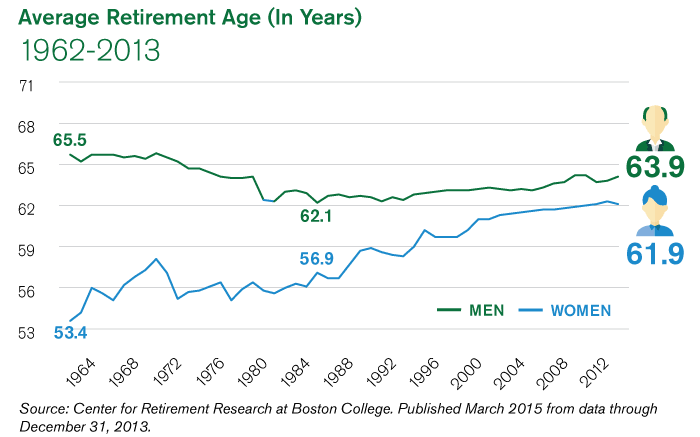
Chart: Average Retirement Age for Men is 64 and for Women it is 62


  • Monthly Social Security benefits claimed at age 70 are more than 70% greater than those claimed at age 62. 

Full story from American Century Investments.
 

Wednesday, April 8, 2015

1 in 3 Covered California Enrollees from 2014 Have Not Re-Enrolled in 2015

This is not a good sign for one of the state exchanges widely held out as being one of the most successful. This likely indicates customer dissatisfaction or adverse selection or both. In any event, burning through and losing a third of enrollees in a year is not a good sign for Covered California.

Link to full study.
 
And this is from John Graham at the National Center for Policy Analysis regarding this study:
This is the problem of increasing churn which we have discussed at this blog. People are likely churning – within the year – between Obamacare, Medicaid, and employer-based coverage at a higher rate than before Obamacare. This surely jeopardizes continuity of care.
 

Legislature Pushes to Extend Health Insurance and Other Legal Rights to Illegal Immigrants in California


From Judy Lin of the Associated Press:
... California Democrats on Tuesday announced a package of 10 bills that would extend health care, legal rights and business protection to immigrants who are illegally living in the state.
Assembly Speaker Toni Atkins, D-San Diego, and Senate President Pro Tem Kevin de Leon, D-Los Angeles, led the majority party's push to expand health coverage to all Californians, regardless of their immigration status, although they are not proposing any funding to pay for the extensions.
"Today we remind the rest of the nation that California is different," de Leon said at a news conference in Sacramento attended by immigrant-rights advocates and families with members in the country illegally. ...
 

Tuesday, April 7, 2015

When the Intranet or Email are Not Enough: Rules for Electronic Disclosure of Your Health and Welfare Plan Documents

...[P]lan sponsors ask all the time if they can just e-mail plan documents to employees to satisfy the notice requirements, or maybe just post new plan documents on the company intranet.  Well, the recent decision in Thomas v. CIGNA (E.D.N.Y.) serves as a reminder that the short answer to that question is no. ...
There are actually rules that govern electronic disclosure of plan documents.  If employees have work-related computer access, ERISA disclosures may be delivered electronically, or posted on the intranet, if the employees have the ability to effectively access documents furnished in electronic form at any location where the employee is reasonably expected to perform his duties, and are expected to have access to the employer’s electronic information as an integral part of those duties.  It is not enough that they have access somewhere at work or have access at a common location (like a break room).  Accessing the computer has to be an actual requirement for their job function. 
Documents can still be sent to employees and beneficiaries without work-related access to a computer as long as additional requirements are met.  The employer or plan administrator must first obtain a consent form signed by the employee or beneficiary that specifically states the following: 
The names or types of documents to which the consent applies
  • A sentence stating that consent can be withdrawn at any time without charge
  • An e-mail address where the employee will be able to receive future announcements and/or documents if sent by e-mail
  • The procedures for updating the e-mail address used for receipt of electronically furnished documents
  • The procedures for withdrawing consent
  • The right to request and obtain a printed version of an electronically furnished document and, if there is a charge for the printed document, how much it will cost.
  • The computer hardware or software needed to access and download the electronically delivered documents.
  • If the plan administrator changes the hardware or software requirements, it must provide a new notice and obtain a new consent.
Without this consent, electronically providing documents is not sufficient.  Hard copies have to be provided. ...
The whole post is worth a read here.
 

Social Anxiety Disorder and Difficulty in "Interacting with Others" Is Now Disability Under the Americans with Disabilities Act

... The federal district court granted summary judgment in favor of the [employer], finding that Jacobs’ social anxiety disorder was not a disability as a matter of law under the ADA. 
On appeal, however, the Fourth Circuit reversed that dismissal, agreeing with the EEOC’s view that interacting with others is a major life activity, and pointing out that the Diagnostic and Statistical Manual’s fourth edition (DSM-IV) describes social anxiety disorder as a condition that “interferes significantly with the person’s normal routine, occupational . . . functioning, or social activities or relationships.” Therefore, under the ADA, social anxiety disorder would be viewed as a disability. 
The court’s opinion includes a detailed explanation of the mistaken analysis of the district court. While the opinion includes numerous important analytical points – specifically including the analysis of social anxiety disorder as a per se disability under the ADA – the court raised two additional issues of which employers should take particular note. ...
  

Why the Annual Physical Is Not a Good Idea for Healthy Adults

This from Jenny Gold at Kaiser Health News:
... [T]here’s little evidence that [annual physicals] actually do any good for healthy adults.... 
“I would argue that we should move forward with the elimination of the annual physical,” says Dr. Ateev Mehrotra, a primary care physician and a professor of health policy at Harvard Medical School.
Mehrotra says patients should really only go to the doctor if something is wrong, or if it’s time to have an important preventive test like a colonoscopy. He realizes popular opinion is against this view. “When I, as a doctor, say I do not advocate for the annual physical, I feel like I’m attacking moms and apple pie,” Mehrotra says. “It seems so intuitive and straightforward, and [it’s] something that’s been part of medicine for such a long time.”
But he says randomized trials going back to the 1980s just don’t support it.
The Society for General Internal Medicine even put annual physicals on a list of things doctors should avoid for healthy adults. One problem, Mehrotra says, is the cost. Each visit usually costs insurers just $150, but that adds up fast.
“We estimate that it’s about $10 billion a year, which is more than how much we spend as a society on breast cancer care,” Mehrotra says. “It’s all a lot of money.”
And then there’s the risk that a doctor will run a test and find a problem that’s not actually there. It’s called a false positive, and it can lead to a cascade of follow-up tests that can be expensive and could even cause real harm. Dr. Michael Rothberg is another primary care physician and a health researcher at the Cleveland Clinic. He generally avoids giving physicals. ...

PPACA Exchange Enrollments Have Hit a Wall, Why?

... Exchanges needed to enroll up to 75% of their eligible markets, according to Kingsdale. But states are having trouble getting over the 40% mark. ... 
Why aren't they enrolling? Industry analyst Robert Laszewski crunched numbers and finds that for many, ObamaCare remains a pretty lousy deal. On his blog he notes, for example, that a family earning 253% of the poverty level would get an average of $3,534 in subsidies this year. But they'd still owe $4,934 in premiums for a Silver plan with a $2,700 deductible. 
"How many families making $60,000 have an extra $4,934 in their budget for a policy that will likely pay them almost nothing?" If that family decides to pay the penalty, it would cost them a much lower $975, according to the Tax Policy Center. 
Laszewski says that more outreach to these families "will do no good as long as the Obamacare value proposition for these people is unacceptable to them."